Saffron has been used for over 3,500 years — in Persian royal kitchens, Mughal banquets, Mediterranean medicine, and Kashmiri weddings. For most of that history, its value was understood intuitively: a tiny pinch could turn a pot of milk golden, perfume a whole room, and leave a flavour that no other spice could replicate.
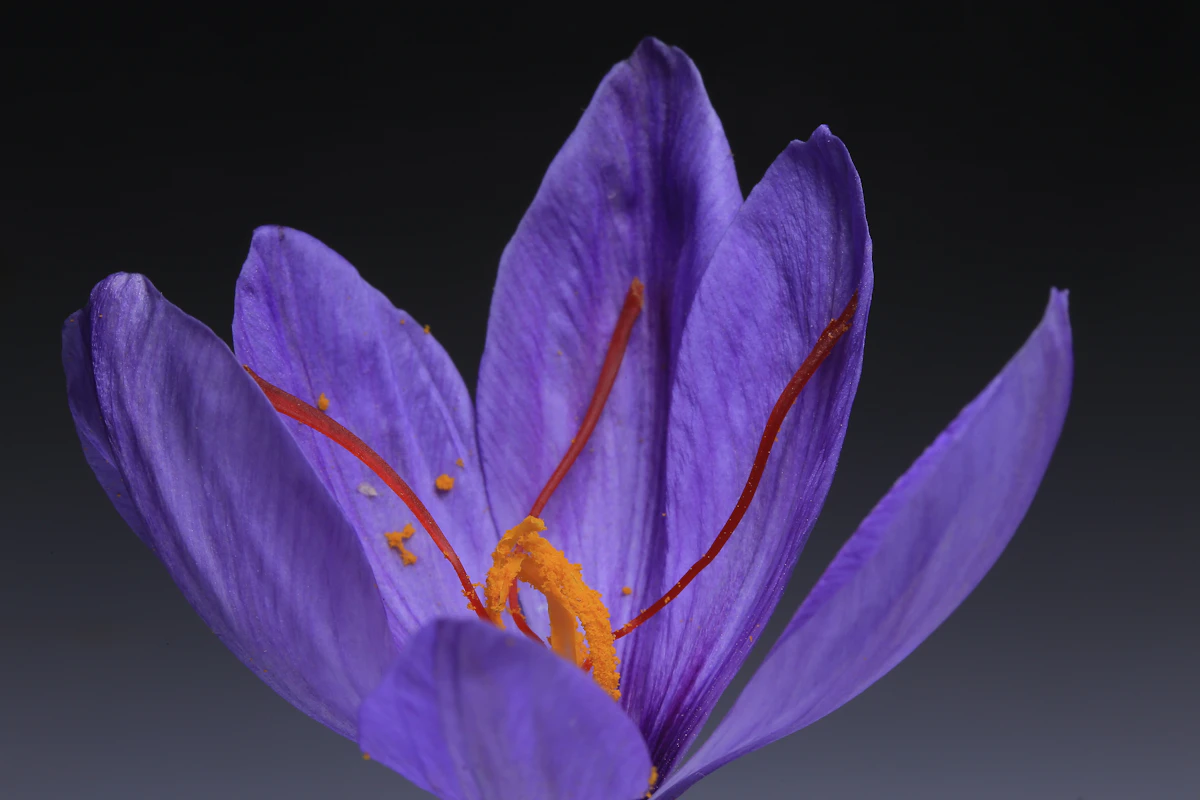
Today we know exactly why. Three organic compounds, produced by the stigma of Crocus sativus, account for every sensory property that makes saffron worth more than gold by weight.
Infographic — The Three Compounds of Saffron Quality
- • Water-soluble carotenoid
- • ISO min: ≥ 190 (Cat I)
- • Super Negin: ≥ 250–270
- • Turns water golden in 15–20 min
- • Volatile monoterpene aldehyde
- • ISO range: 20–50
- • Earthy, floral, hay-like scent
- • Degrades with heat and light
- • Bitter glycoside
- • ISO min: ≥ 70 (Cat I)
- • Super Negin: ≥ 85–90
- • Breaks down to form Safranal
Crocin: Why Your Biryani Turns Golden
Crocin is a family of water-soluble apocarotenoid esters — the only carotenoid pigments that dissolve readily in water (most carotenoids, like beta-carotene, are fat-soluble). This is why saffron releases its colour into water and milk-based dishes but colours fatty dishes less efficiently unless you first bloom the threads in warm liquid.
The ISO 3632 standard measures Crocin as absorbance at 440 nm wavelength (A₄₄₀) — essentially how much yellow-gold light the solution absorbs. A result of 250 means one gram of saffron, dissolved in 1 litre of water, absorbs 250 units of 440 nm light. Super Negin typically scores 250–290.
Crocin is heat-stable, which is why you can add saffron to boiling rice and the colour survives. It is, however, sensitive to strong acids and prolonged exposure to UV light — hence UV-protected glass jars.
“A Crocin score of 270 means your saffron is working at nearly three times the intensity of the minimum acceptable product sold in supermarkets.”
Safranal: The Scent That Fills a Room
Safranal (2,6,6-trimethylcyclohexa-1,3-diene-1-carboxaldehyde, if you prefer) is not present in fresh saffron stigmas at all. It forms through enzymatic and heat-driven breakdown of Picrocrocin during the drying process. The better the drying technique, the more Picrocrocin converts to Safranal — which is why controlled-temperature drying produces more aromatic saffron than sun-drying.
Safranal is volatile: it evaporates at room temperature, which is why saffron loses its fragrance over time, especially in loosely sealed containers. Airtight storage extends the aromatic life significantly — in a sealed UV jar at room temperature, Safranal degrades by roughly 15 % per year.
Infographic — How Saffron Changes with Drying and Storage
Relative values, normalised to fresh stigma = 100.
Picrocrocin: The Bitter Backbone
Picrocrocin is responsible for saffron's characteristic bitter taste — the quality that distinguishes it from simply adding food colouring to a dish. As a glycoside, it is water-soluble and begins breaking down during cooking, releasing its bitter notes into the dish and simultaneously generating more Safranal aroma in the presence of heat.
This is why saffron-infused dishes have a flavour that builds and deepens as they cook: Picrocrocin is continuously generating both bitterness and aroma throughout the cooking process.
How to Maximise All Three Compounds in Cooking
- Bloom in warm liquid first. Steep threads in 3–4 tablespoons of warm water, milk, or stock for at least 15 minutes before adding to your dish. This extracts Crocin and begins Picrocrocin breakdown, maximising both colour and flavour payoff.
- Use warm — not boiling — blooming liquid. Above 70 °C, Safranal begins to volatilise rapidly. Steep at 40–60 °C for the best aroma preservation.
- Add bloomed saffron early. For rice dishes, add with the initial liquid. This gives Crocin time to distribute evenly throughout the dish.
- Do not grind unless necessary. Powdered saffron disperses more easily but loses Safranal faster due to increased surface area. Use threads wherever possible.
“The single best thing you can do for your saffron dishes is to bloom the threads in warm (not hot) liquid for at least 15 minutes before using.”
Why ISO Minimum Thresholds Matter
The ISO 3632 Category I minimums — Crocin ≥ 190, Safranal 20–50, Picrocrocin ≥ 70 — represent a floor, not a goal. Super Negin from Kashmir regularly scores Crocin 260–290, Safranal 30–45, and Picrocrocin 85–95. These aren't marginal improvements; they translate directly to using roughly 40 % less saffron per dish to achieve the same result as a minimum-spec product.